Posts

Weekly Soul - Week 20: Quality of Attention
Image
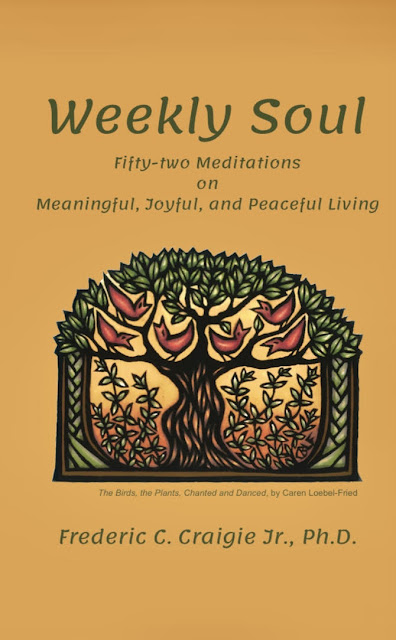
  Today's meditation from Weekly Soul: Fifty-two Meditations on Meaningful, Joyful, and Peaceful Living by Dr. Frederic Craigie. -20-   The quality of one's life depends on the quality of attention. Whatever you pay attention to will grow more important in your life. Deepak Chopra   Achieving artistic and financial success by the early 1890s, Claude Monet purchased his home in Giverny, France and set to work developing a landscape that would inspire his painting in the last 30 years of his life. He received permission from local authorities to divert water from the Epte River to create a pond for cultivating water lilies. Monet spent long hours in his gardens, tending to them, and joyfully observing the constant unfolding of light, colors, and texture. He commented on his attention to his lily pond:   It took me a while to understand my water lilies. I cultivated them without thinking about painting them. A landscape doesn’t captivate you in just one day. And then, ...

The Source for Emotions

Image
  How Emotions Are Made by Lisa Feldman Barrett argues something that initially sounds almost unbelievable: Emotions are not pre-packaged reactions hidden inside us waiting to “come out.” Instead, the brain constructs emotions. That sounds strange because most of us intuitively think emotions work like reflexes: something happens the brain detects it an emotion fires automatically Barrett argues it is more complicated than that. The Brain as a Prediction Machine Her central idea is that the brain is constantly trying to predict what is happening and what the body needs next. Your brain is not passively receiving reality like a camera. It is actively: interpreting sensory input predicting meaning preparing bodily responses using past experience to make sense of present sensations So when your heart races, stomach tightens, breathing changes, and attention narrows, the brain has to answer: “What does this mean?” And the answer is not always fixed. T...

The Core Divide: Weak Leaders vs. Strong Leaders

Image
  Leadership isn’t defined by position; it’s revealed by posture. The difference between weak and strong leaders isn’t in their titles — it’s in how they handle truth, power, and people. 1. Relationship with Truth Weak leaders distort truth to protect their image. They curate narratives, avoid transparency, and punish honesty. Strong leaders pursue truth even when it’s uncomfortable. They see reality as the raw material for improvement, not a threat to authority. Truth is the mirror that weak leaders avoid and strong leaders polish. 2. Relationship with Power Weak leaders hoard power to feel secure. They confuse control with competence. Strong leaders distribute power to build capacity. They understand that shared agency multiplies results. Power kept is fragile. Power shared is durable. 3. Relationship with Feedback Weak leaders hear feedback as accusation. Strong leaders hear feedback as intelligence. The weak defend their ego; the strong defend their mission. 4. Relationsh...