Posts

Showing posts matching the search for Kupchanka

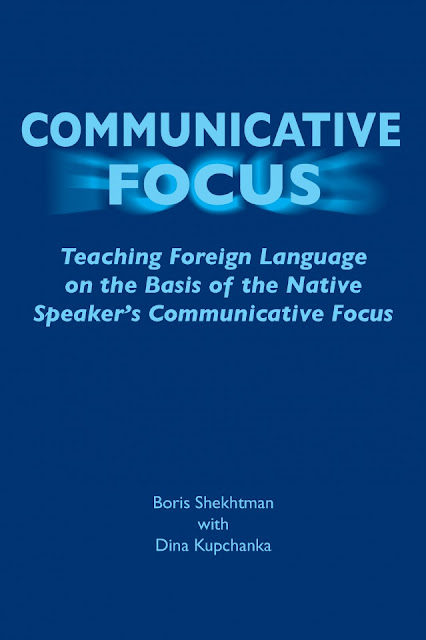
Released! Audiobook for Communicative Focus (Shekhtman & Kupchanka)
Image
  Recently released - the audiobook for Communicative Focus  by Boris Shekhtman and Dina Kupchanka. In the current volume, the author describes in detail the theory and nature of the principles and practices used in his approach to language teaching. He is not afraid to talk about some aspects of language learning and teaching, such as the development of lexical and grammatical accuracy, as well as the need for memorization and the development of memory, that have been increasingly omitted from the classroom as a result of the rise in popularity of theories that debase their significance but which are very important, especially if students are to reach the highest level of proficiency. He also discusses some ideas, such as the unique nature of the connection between language and meaning that native speakers experience that non-native speakers must learn to deal with-in differing ways at differing levels of proficiency. His focus throughout is on communication and the nature of...

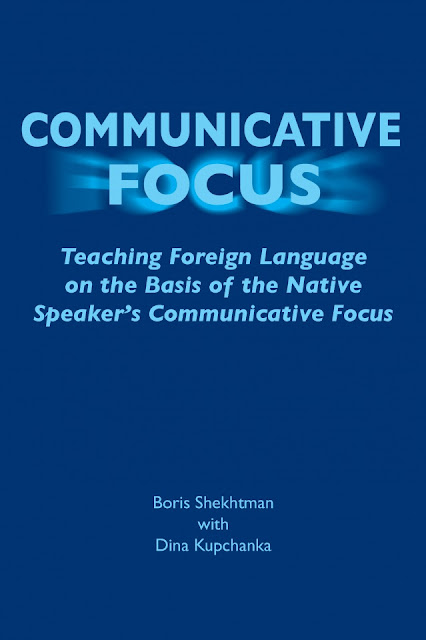
Daily Excerpt: Communicative Focus (Shekhtman & Kupchanka)

Image
  Today's excerpt comes from  Communicative Focus  by Boris Shekhtman and Dina Kupchanka -  CF and Traits of Language Learning Individuals     The LCF individual focuses first of all on how to say what he or she wants to communicate. For this individual, how usually requires more attention and effort than what ; in other words, the mechanical plane of communication is more important than the ideational plane. As a result of this the LCF students have one main problem: pausing. Very often the pause reflects the extra time it takes for the LCF to prepare an answer using a low automated pattern. The LCF individual also has to hunt for low automated words to express his or her thoughts. This creates pauses between sentences and between words within sentences. In addition, when the LCF person makes mistakes, whether of grammar or vocabulary (because of low automaticity), he or she often notices his or her mistakes and immediately corrects them, which again give...

Announcing a New Affiliated Book: How to Use Your Russian in Communication Effectively

Image
  MSI Press has added to its collection of affiliated books, a self-published book edited by Boris Shekhtman, a prolific author of MSI Press books and books published by Cambridge University Press. Contributing authors include Dina Kupchanka (Specialized Language Training Center), Natalia Lord (Foreign Service Institute), and Svetlana Sibrina (Specialized Language Training Center).   To purchase this book on Amazon. click HERE . For more posts and Boris Shekhtman and his books, click HERE . For more posts about Dina Kupchanka, click HERE . For more posts on language learning, click HERE . To see more affiliated books and learn about affiliated status, click HRE . Sign up for the MSI Press LLC newsletter.

Just Released: E-Book Version of Communicative Focus (Shekhtman and Kupchanka)

Image
  Communicative Focus (Shekhtman and Kupchanka) which has been read for language instructors for year is now available as an e-book. At last! Book description: In the current volume, the author describes in detail the theory and nature of the principles and practices used in his approach to language teaching. He is not afraid to talk about some aspects of language learning and teaching, such as the development of lexical and grammatical accuracy, as well as the need for memorization and the development of memory, that have been increasingly omitted from the classroom as a result of the rise in popularity of theories that debase their significance but which are very important, especially if students are to reach the highest level of proficiency. He also discusses some ideas, such as the unique nature of the connection between language and meaning that native speakers experience that non-native speakers must learn to deal with-in differing ways at differing levels of proficiency. Hi...

The Story behind the Book: Communicative Focus (Shekhtman & Kupchanka)

Image
  Communicative Focus  was written through collaboration of Boris Shekhtman, who had left the Foreign Service Institute to open his own highly successful private school, using language teaching techniques that were quite unique but extremely effective, and Dina Kupchanka, a young teacher who taught for him.  The realization of the principles introduced in  Communicative Focus  had appeared earlier as actual classroom exercises in several publications, a book published by Cambridge University Press ( Developing Professional-Level Foreign Language Proficiency ),  How to Improve Your Foreign Language Immediately  (an immensely popular book published by MSI Press), and articles in the Journal for Distinguished Language Studies. The theory behind these activities had never been spelled quite so explicitly before (lack of room in the previous publications to include theory). Further, it took some time before the profession was ready to move on from teaching ...

Daily Excerpt: Communicative Focus (Shekhtman and Kupchanka) - defining and evaluating communicative focus

Image
  Today's excerpt comes from  Communicative Focus  by Boris Shekhtman and Dina Kupchanka -  The Communicative Focus          We call the correlation between ideational and mechanical planes of speech Communicative Focus (CF). This term was introduced by Betty Lou Leaver and Boris Shekhtman (2002) in the book Developing Professional-Level Language Proficiency . CF convincingly reveals the communicative essence of a person's speech and shows that communicative quality of speech, first of all, depends on how automatic this person is in expressing his or her ideas.     This correlation may have different modes. The ideational and mechanical planes may coincide with each other, which makes CF completely automatic, and this coincidence means that ideational plan has enough controlled mechanical elements to express itself. The ideational plane and mechanical planes may not coincide with each other to this or that de...

📌 Stuck at Level 3: Linguistic Fossilization

Image
  Many language learners plateau at Level 3—Professional Proficiency—not because they lack motivation or exposure, but because they’ve unknowingly become trapped in a phenomenon known as linguistic fossilization. Fossilization refers to deeply ingrained errors in grammar (morphology and syntax), vocabulary, intonation, and pronunciation. These errors persist despite continued use of the language, often because they’ve been repeated so frequently that they become automatic. And here’s the catch: Level 4 proficiency demands not just fluency, but accuracy—a level of precision that fossilized habits simply can’t support. The late Boris Shekhtman, a revered Foreign Service Institute instructor and author of How to Improve Your Foreign Language Immediately , was a master at helping learners break free from this linguistic quicksand. He coined the term “self-drilling” to describe how learners inadvertently reinforce errors through repetition. His solution? Drill correct forms two to thr...

Learn Language Like a Diplomat. Seriously.

Image
  Ever seen those planes in airplane magazines -- learn languages like a diplomat? The implication is that a course being sold teaches you like diplomats are taught. Misleading. I taught diplomats for six years. While the "courses" are generally ripped off, older, public-domain courses that very likely were used at the Foreign Service Institute at some point in time, they actually do not represent how diplomats are taught since diplomats learn language from interactions with skilled teachers, working in highly individualized environments and very small classes. Very little of what they do in their intensive day-long classes can be represented in a textbook, which generally is just a jumping-off point for work on language development.  That said, a few MSI Press books are written or edited by teachers who did teach or supervise teaching programs for diplomats. They wrap the theory in content meant for non-diplomats, self-learners, or specific kinds of language classes in ways ...