Posts

Showing posts matching the search for karnes

When Pets Are Dying: Help in Understanding the Process and the Decisions

Image
  When my beloved Murjan was dying from cancer , I was desperate for information, but my husband was dying from cancer at the same time, which gave me very little time for seeking out answers. Murjan was almost 19 years old and had been on chemotherapy for three years. His vet did not know how to help him further, but she apparently did not want to admit that -- and subconsciously I did not want to admit that she did not know what to do and had essentially given up on him. I was unable to get timely appointments, or any appointments at all, even in the emergency room. We do not have any vets in town. I have to travel no matter what. Murjan's vet was located an hour north of us. To get help, I contacted other vets. A vet to the west of us recommended hydration, and so we stated hydrating Murjan every other day. His vet to the north allowed as to how that might help. But Murjan kept losing weight. He was down to 5 pounds (from 16 pounds) when he died.  Finally, a vet to the sou...
Cancer Diary: The Stages of Dying Guide We Used to Accompany Carl in His Dying

Image
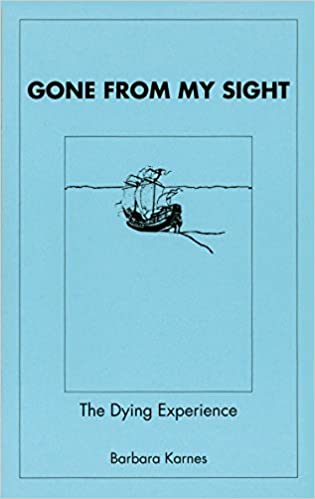
One of the most comforting and helpful resources we found when Carl was in the final days of hospice -- more helpful than what hospice workers could tell us and more than doctors did tell us -- was a little book, called Gone from My Sight: The Dying Experience by Barbara Karnes, RN. As Carl went through each predicted and predictable stage from being distant mentally, to not eating, and then to not drinking, this little book told us the range of expectations and what was happening to his body in preparation for death in relation to what he was and was not doing. The book description on Amazon is very accurate:  The biggest fear of watching someone die is fear of the unknown; not knowing what dying will be like or when death will actually occur. The booklet "Gone From My Sight" explains in a simple, gentle yet direct manner the process of dying from disease. Dying from disease is not like it is portrayed in the movies. Yet movies, not life, have become our role models. Death ...

Cancer Diary: Some Doctors Will Not Recommend Hospice until Too Late

Image
  I like to follow the blog of Barbara Karnes , hospice nurse par excellence. Much of what she has to say to hospice nurses about end-of-life issues in general apply to caregivers of cancer patients in particular. Her latest post, " For some doctors, it just isn’t in their tool kit to stop trying to treat,"  reflects our experience very well. Only when Carl fell and needed four people to lift him and get him to the hospital and x-rays showed complete take over by cancer of four major organs along with blood clots in his legs and lungs did the doctor suggest hospice (although he also expressed a willingness to continue treatment -- a different treatment -- if we wanted). We chose hospice, but the period of time was short. Carl returned from the hospital and went on hospice August 7. He died August 16. I have always wished that the doctor had put the hospice option in front of us much earlier, perhaps even at the beginning of the 5-month period during which the doctor tried eve...

Cancer Diary: Managing Pain at the End of Life

Image
  When Carl lay dying in home hospice, we were given three vials of morphine for pain. Oddly, we used very little of it. He did not need or want it. At one point, his liver was grieving him, and we gave him a small amount and called the hospice to find out what we should be giving since the bottle said only "as needed." We were told that we had given a pediatric dose -- for a 300-pound man. He did not seem to need more at that time, though, but the next couple of days, a couple of times, he indicated he was in mild pain, and we tripled the dose as suggested by the nurse. He, however, after that, never indicated he was in pain. Our son asked if he might like to be given at least a small dosage prophylactically, to which he responded, "You wanna turn me into a dope addict?" Carl had a limited tolerance for pain all his life, so if he said he was not in pain, he was indeed not in pain. Had he been in pain, he would have taken anything and everything available!  The opp...

Cancer Diary: "Caring for Someone Who is Dying Is Different from Caring for Someone Who Is Going to Get Better" (Karnes)

Image
  I have raised two children who were not supposed to live because of the type of birth defects they have. Today, both are in their 40s. I know how to care for someone whom I honestly believe will -- and who does have a hope to -- get better. There was always the struggle of making sure they got the meds they needed, that they did the kinds of activities they needed to do, that their father, Carl, and I researched everything that was going on in medical research about their defects and brought it up to their doctors, and that we interacted actively with all specialists working with them, asking for clarification for us at time and for them at times, ensuring that they knew as much or more than we did. It was purposeful care that had an expected point of diminishing need, with the reins turned over to the children as time passed. Time, then, was a positive. It allowed us to build a brighter future than an initial diagnosis proposed. Things got better over time. The kids gained skill...

Cancer Diary: Late-Stage Cancer Diagnosis: Fast-Tracking Decision-Making on a Roller Coaster

Image
  Earlier, I wrote about the two paths that erupted in front us when faced with a late-stage cancer diagnosis: to focus on living or to focus on dying. There are so many problems and so much confusion when told after a fall or a blood test or something else that seems otherwise innocuous that your loved one has advanced stage 4 cancer.  The worst thing about a late-stage diagnosis is time, or the lack thereof. Not just the time left for a cancer victim to live, but the time available to make decisions.  The first decision--to treat or go on hospice --is a significant one, and there is often no time to really think in through. From my own experience with more than one relative diagnosed with more than one kind of cancer at an advanced stage, there is an automatic, nearly instinctive choice made, not a reasoned one. Got insurance? Treat the cancer. Don't have insurance? Don't treat the cancer. Those are clearly not the most logical or even medically best or viable criteria...

Cancer Diary: Emotions and Cancer

Image
  I recently read a great blog post from Barbara Karnes, a hospice guru, who has done much to help dying patients and their families travel the path to death with equanimity. Her most recent blog post, " When our emotions blind us from what is happening ," rings true for cancer and any other fatal illness and is well worth reading. For other Cancer Diary posts, click  HERE . Blog editor's note: As a memorial to Carl, and simply because it is truly needed, MSI Press is now hosting a web page,  Carl's Cancer Compendium , as a one-stop starting point for all things cancer, to make it easier for those with cancer to find answers to questions that can otherwise take hours to track down on the Internet and/or from professionals. The CCC is expanded and updated weekly. As part of this effort, each week, on Monday, this blog will carry an informative, cancer-related story -- and be open to guest posts:  Cancer Diary .   Sign up for the MSI Press LLC newsletter Follow MS...

Cancer Diary: BURNOUT! REMORSE! GRIEF!

Image
  Cancer, like other debilitating illnesses, require immense effort from those taking care of the cancer-stricken patient. This effort can be redoubled and accompanied by a range of personally invested emotions when the caregiver is a relative, particularly a spouse. Cleveland Clinic says"  Caregiver burnout is a state of physical, emotional and mental exhaustion that happens while you’re taking care of someone else. Stressed caregivers may experience fatigue, anxiety and depression.      To that, I would add anger -- followed by remorse. In waves and cycles. Never feeling good about yourself. And then feeling guilty from the sense of relief after the cancer-stricken relative dies. Being able to understand oneself and forgive oneself can lead to stabilization and at least some aspect of comfort (unfortunately, often months after the patient has died). This article can help wtih the understanding and forgiving part:  Caregiver Burnout: What It Is, Signs Yo...

Cancer Diary: Contours of the Last Days

Image
  There’s more hope these days when it comes to cancer—if it’s caught early, you’ve got a fighting chance. But people still die. Every year, every month, every day. Carl did. And recently, I stumbled across an article I wish had found its way to me before he died. It was written by Barbara Karnes, and it laid out something I hadn’t heard said quite so plainly before: “We die the way we live.” That line stopped me cold. Because she’s right—at least about Carl. He was an introvert to the core. Even after his diagnosis, there were no late-night heart-to-hearts, no raw confessions, no leaning into each other with the kind of aching honesty I craved. He simply couldn’t go there. And that silence—it wears on a caregiver. Carl was also an ostrich. I don’t say that with judgment. It’s just... true. All through our life together, I handled the hard stuff. He stayed sunny, cheerful, often by refusing to acknowledge the storm clouds altogether. Denial was his way of coping. It was how he kep...