Posts

Showing posts matching the search for native like

The Case for Native-Like Foreign Language Proficiency: Advocacy as a Life Skill

Image
  Native‑like proficiency in a second language isn’t about perfection or accent mimicry. It’s about power — the power to advocate for yourself wherever you happen to live, work, study, or seek care. When you operate in a language that isn’t your own, every interaction carries an extra layer of vulnerability. The stakes rise not because you are less intelligent or less capable, but because persuasion, nuance, and sociolinguistic cues shift across languages. To navigate institutions, negotiate needs, and protect your well‑being, you need more than vocabulary. You need rhetorical fluency. Advocacy requires more than “getting by” Most people can reach a functional level in a second language: ordering food, asking for directions, chatting with neighbors. But advocacy lives in a different register. It demands: Precision — the ability to describe symptoms, needs, or concerns without ambiguity. Persuasion — knowing how arguments are framed, softened, intensified, or made culturally accep...

The Case for Native-Like Foreign Language Proficiency: The Need to Supervise Native Speaker Employees

Image
There is a persistent myth in American professional culture that basic, transactional language ability is “good enough” for international work or for supervising immigrant employees. As long as you can point, gesture, and string together a few nouns and verbs, you’re told you can “get by.” But getting by is not the same as leading , managing , or building trust . And it is certainly not the same as supervising native speakers — whether you are working in their country or they are working in yours. Native-like proficiency is not about perfection. It is about functional authority , cultural intelligence , and linguistic credibility . Without those, supervision becomes guesswork, and guesswork is not leadership. 1. Supervising Native Speakers Requires More Than Vocabulary When you supervise someone in their own language, you are not simply exchanging information. You are: evaluating performance giving corrective feedback interpreting tone, nuance, and implication reading between the line...

Daily Excerpt: Communicative Focus (Shekhtman) - Communication between Native Speakers and Non-native Speakers and the Essence of Speech

Image
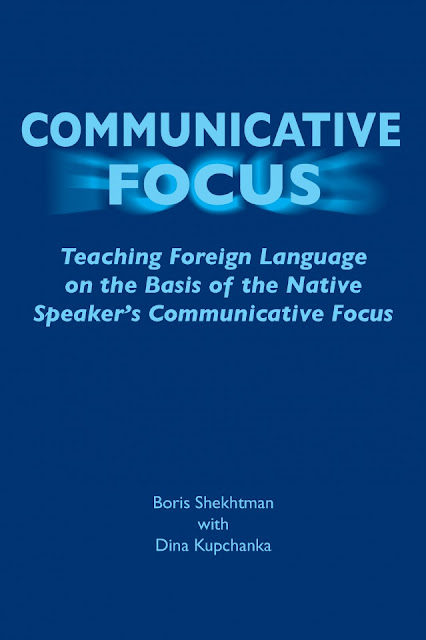
    Today's excerpt comes from Communicative Focus  by Boris Shekhtman and Dina Kupchanka -  Communication between Native Speakers and Non-native Speakers and the Essence of Speech We are interested in communication between native and non-native speakers for one very important reason: this is the kind of communication for which all teachers are essentially preparing students. Regardless of the level of our students, whether they are beginners or already near-native speakers, if they want to use their second language, they nolens-volens enter this type of communication. We need to help them to participate in this communication with dignity and power and to close the gap between their language skills and those of native speakers. In order for us to prepare our students in this way, we must be knowledgeable about the specific nuances of verbal communication between native and non-native speakers.     The most obvious difference between the language perfor...

Teaching and Learning to the Highest Levels of Language Proficiency - Sharings from the Journal of Distinguished Language Proficiency and More (Book Review by N. Lord)

Image
  Book review from Issue 8 of the Journal for Distinguished Language Studies -- REVIEW   Dornyei, Zoltan; Mentzelopoulos, Katarina Lessons from Exceptional Language Learners Who Have Achieved Nativelike Proficiency: Motivation, Cognition and Identity Channel View Publications 2022   Series Editors: Sarah Mercer, Universitat Graz, Austria and Stephen Ryan, Waseda University, Japan Psychology of Language Learning and Teaching: 18 Bristol; Jackson: Multilingual Matters, (2022)   Natalia Lord, Learning Consultation Service, School of Language Studies, Foreign Service Institute (retired)   SUMMARY   This book analyzes the findings of a research project that Zoltan Dornyei, a prolific and esteemed contributor to the field of language learning, designed for his students at the University of Nottingham, when his course, the Psychology of Bilingualism and Language Learnin g , moved online. This is unfortunately a posthumous publication, for Zoltan Dornyei passed aw...