Posts

Showing posts with the label aesthetics

What Role Can Philosophy Play in a Modern Society?

Image
  In an age defined by speed, noise, and relentless change, philosophy can seem like a relic—something dusty, academic, or detached from the “real world.” Yet the opposite is true. The more complex our world becomes, the more essential philosophy becomes. It is not a luxury. It is a navigational tool. Philosophy is the discipline that asks the questions modern life tries to outrun: What matters? What is true? What is good? How should we live? And in a society saturated with information but starved for meaning, those questions are not abstract—they are survival skills. 1. Philosophy Helps Us Make Sense of Complexity Modern society is a tangle of competing values: technological innovation, economic pressure, social justice, environmental urgency, personal autonomy, communal responsibility. We live inside contradictions. Philosophy doesn’t solve contradictions; it teaches us how to think within them. It gives us frameworks for evaluating claims, weighing evidence, and understandin...
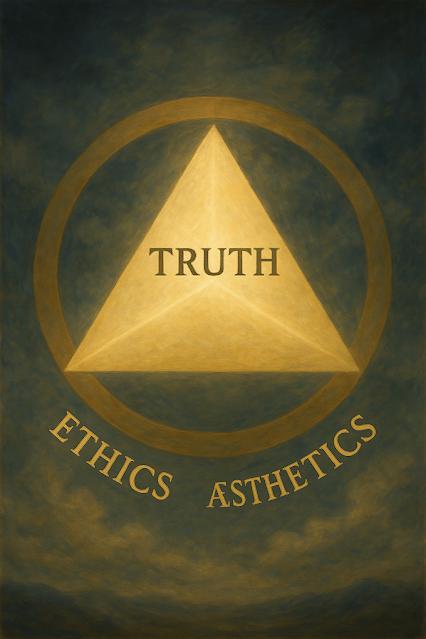
Truth, Ethics, and Aesthetics: A Three-Way Mirror

Image
  In a world increasingly shaped by metrics and immediacy, the trio of truth, ethics, and aesthetics might seem like distant cousins—each speaking its own language, each pursuing its own ideal. But look closer, and you’ll find they’re reflections in the same mirror, bending light toward meaning. 🧭 Truth: The Compass Truth is often cast as the cold, hard compass—pointing us toward what  is , regardless of what we  wish  it to be. But truth isn’t just factual; it’s relational. In caregiving, for instance, truth might mean acknowledging decline while still honoring dignity. In art, it might mean revealing a deeper reality through metaphor. And in ethics, truth becomes the foundation for moral reasoning—what we owe to others, and why. ⚖️ Ethics: The Anchor Ethics asks:  What should we do?  But it also asks:  Who should we be?  It’s the anchor that holds us steady in turbulent waters. Yet ethics without aesthetics can become rigid, and ethics without ...

Truth, Ethics, and Aesthetics: A Three-Way Mirror

Image
  In a world increasingly shaped by metrics and immediacy, the trio of truth, ethics, and aesthetics might seem like distant cousins—each speaking its own language, each pursuing its own ideal. But look closer, and you’ll find they’re reflections in the same mirror, bending light toward meaning. 🧭 Truth: The Compass Truth is often cast as the cold, hard compass—pointing us toward what  is , regardless of what we  wish  it to be. But truth isn’t just factual; it’s relational. In caregiving, for instance, truth might mean acknowledging decline while still honoring dignity. In art, it might mean revealing a deeper reality through metaphor. And in ethics, truth becomes the foundation for moral reasoning—what we owe to others, and why. ⚖️ Ethics: The Anchor Ethics asks:  What should we do?  But it also asks:  Who should we be?  It’s the anchor that holds us steady in turbulent waters. Yet ethics without aesthetics can become rigid, and ethics without ...